
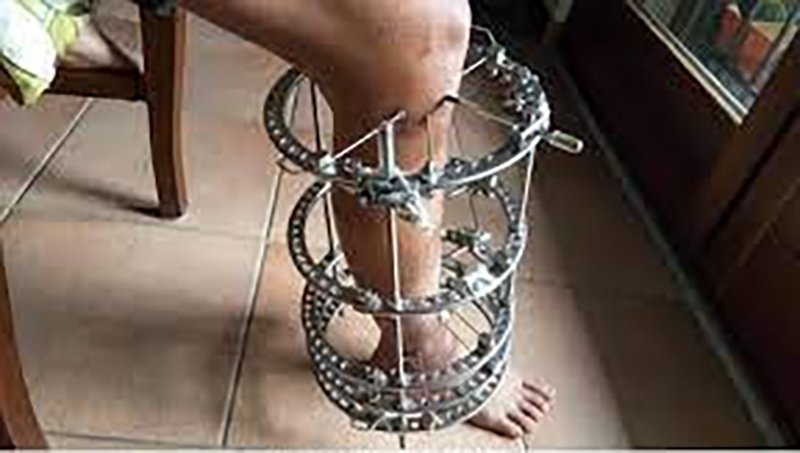
Limb lengthening is achieved using the body's own capacity to regenerate new bone as well as the soft tissues, ligaments, blood vessels, and nerves that surround and support it. The process begins with an operation called an osteotomy, in which the orthopaedic surgeon cuts the bone to be lengthened. The limb (usually the upper or lower leg) is then stabilised using one of several different external and/or internal fixation devices or frames.
1. External fixator
The fixator remains in place for a few months until the desired increase in height is achieved.
External fixators are metal devices that are attached to the bones of the arm, leg or foot with threaded pins or wires. These threaded pins or wires pass through the skin and muscles and are inserted into the bone. The majority of the device is outside of the body, which is why it is called an external fixator.
External fixators can be used to gradually lengthen a bone, straighten a deformed bone or reduce pressure on a joint through joint distraction.
During surgery, the doctor will make small incisions and then insert pins or wires into the bone. The external fixator frame will be attached to these pins and wires and secured using clamps and rods. If the bone is to be lengthened or straightened, the doctor will then surgically cut the bone (osteotomy) to create two separate bone segments.
After surgery, the bones are allowed to rest for 5 to 7 days to begin the healing process. After this period of time, the distraction phase of treatment begins. The patient (or family member) will be given a schedule that instructs them how to adjust the fixator several times a day by turning small knobs or other parts of the device to slowly pull the bone segments apart. This gradual process of slowly separating the bone segments is called distraction, which means “pulling apart.” As the bone segments are pulled apart at a slow rate of approximately 1 mm (0.04 inches) per day, new bone forms in the space between them. The new bone is called regenerate bone. The distraction phase lasts until the bone is straight or corrected. The patient will need to see the doctor every 10 to 14 days during the distraction phase.
After the correction has been achieved, the consolidation phase begins in which the regenerate bone slowly hardens. During this phase of treatment, the external fixator normally remains in place so that it can support the bone as it heals. The bone has consolidated (“healed”) when the regenerate bone has completely hardened and
calcified. The consolidation phase typical takes twice as long as the distraction phase. For example, if distraction is completed in 1 month, then consolidation will take 2 months. In this example, the external fixator would remain on the patient for a total of 3 months through both the distraction and consolidation phases.